
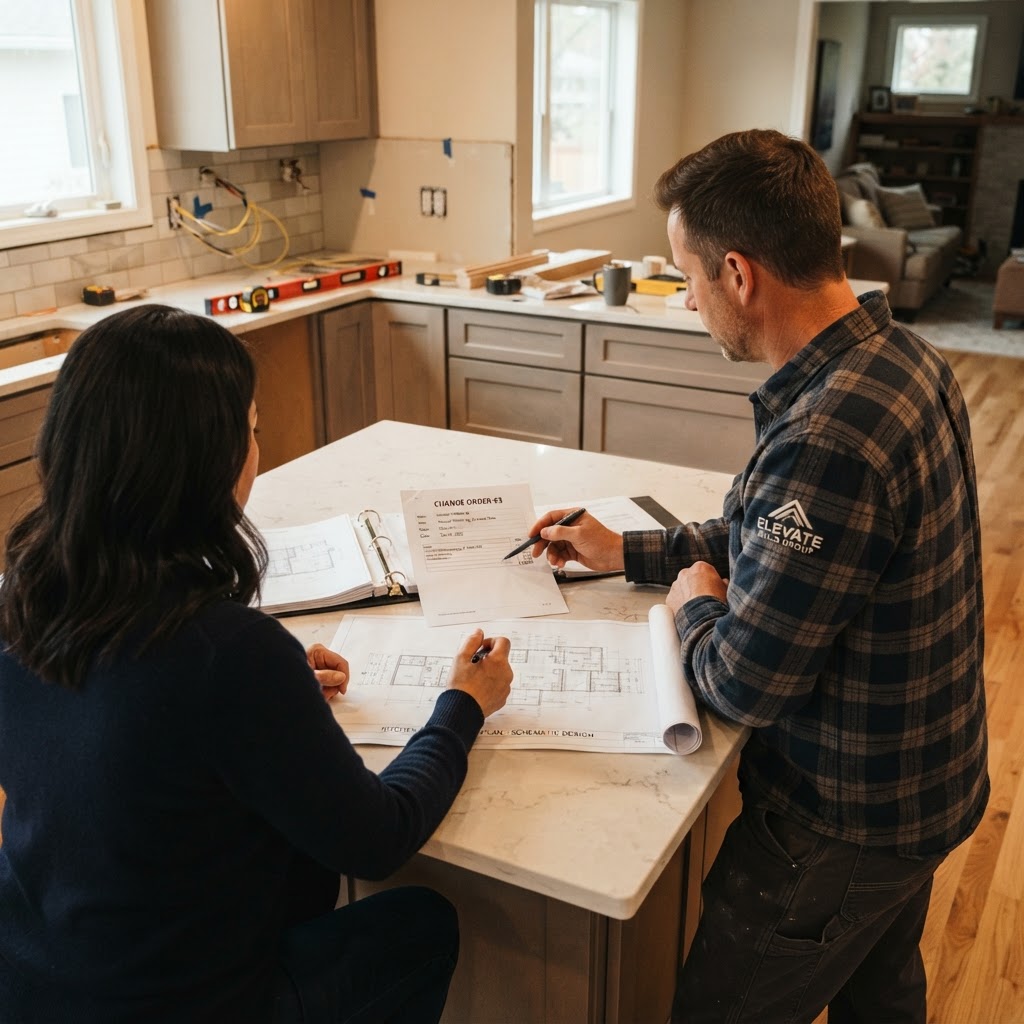
What Actually Happens During a Kitchen Remodel
Most homeowners don't lose sleep over cabinet finishes or faucet styles. They lose sleep over the unknowns of construction — how long the water will be off, whether a crew is going to be walking through the living room for weeks, and whether they need to find somewhere else to eat dinner. Those are fair questions, and they have concrete answers.
The Order Things Actually Happen
A kitchen remodel follows a typical sequence, and understanding it helps explain why certain questions (like "can we get the countertops in faster") have hard limits. In a typical project, the order runs: demolition, rough plumbing and electrical, framing and drywall, paint, cabinet installation, countertop templating, countertop installation, backsplash, flooring if it hasn't already gone in, trim, and final plumbing and electrical connections.
Demolition itself has its own sequence. Appliances get disconnected and removed first, then cabinet doors and drawers, then the cabinet boxes themselves, then countertops, then backsplash, then flooring if it's being replaced, and finally the walls get opened up for any structural or rough-in work behind them. Site protection — floor covering such as ram board or rosin paper, plastic sheeting over doorways, and HVAC filter changes — goes in before any of this starts, per NKBA Kitchen & Bathroom Planning Guidelines, because demolition and drywall work throw off a lot of fine dust that travels further than most people expect.
Do You Need to Move Out?
Whether you need to move out during construction depends on how much disruption your household can realistically tolerate. If you and your family can handle noise, dust, tradespeople moving through the house, a kitchen that's unusable for cooking, and periods without water or power, you may be able to remain in the home for the duration of the project. If those conditions would be too disruptive — because of young kids, a medical need, a work-from-home schedule, or simply a low tolerance for construction chaos — alternate accommodations for part of the project may be the better fit.
NKBA guidance describes a standard temporary kitchen setup: a microwave, coffee maker, and refrigerator relocated to an adjacent room or the garage, a utility sink or basin for washing dishes, disposable plates and utensils, and a plan for meals that don't require cooking. Most kitchen remodels run 4 to 8 weeks depending on scope, per NKBA guidance, and during that stretch you should expect noise, dust, tradespeople moving through the house, and stretches without water or power while lines get cut over or fixtures swapped.
A family of five with one bathroom near the kitchen has a different tolerance for all of this than a couple with a finished basement they can retreat to. Either way, it's worth setting up the temporary kitchen before demo starts rather than scrambling once the sink is disconnected.
Permits: Yes, Usually
Permits are typically required for electrical, plumbing, and structural changes in a kitchen remodel, per the International Residential Code (R301, E3401, P2601). That covers a lot of standard remodel work — moving a gas line for a range, rewiring circuits for new appliances, relocating plumbing for an island sink, or altering a wall that carries load. Permit requirements vary by jurisdiction, so what triggers a permit in one city may be handled differently in another.
This isn't a box-checking exercise. Work performed without required permits may need to be disclosed when you sell the house, and it can affect insurance coverage if something goes wrong later. If a contractor tells you permits aren't necessary for electrical or plumbing work, that's worth a second opinion before you sign anything.
How Cabinets and Countertops Actually Get Coordinated
This is the part of the schedule that trips people up, because it feels like it should be able to move faster than it does. Cabinets are ordered first and installed. Only after they're physically in place does the countertop fabricator come out to template, measuring the exact installed cabinet positions, wall squareness, and appliance clearances, according to NKBA countertop sequencing guidance. Templating must account for the actual conditions on site — the installed cabinet positions, the real squareness of the walls, and the clearances needed for appliances — rather than the original design drawings.
Once that template is taken, countertop fabrication typically takes 5 to 10 business days before installation happens, per NKBA guidance. That gap is normal and it's not wasted time — it's the fabricator cutting stone or solid surface to match your kitchen specifically, not a generic size. Trying to compress this by templating off the cabinet drawings instead of the installed cabinets is how you end up with countertops that don't sit flush or clear an appliance properly.
Backsplash, flooring (if not already down), and trim come after countertops, followed by final connections for plumbing and electrical — running the disposal, hooking up the dishwasher, wiring under-cabinet lighting, and so on.
What This Means for Planning Your Project
A remodel gets planned around scope, layout, materials, coordination, and construction sequencing — and the sequencing piece is often the one homeowners underestimate. Decisions about cabinet layout need to be locked in early because everything downstream (countertop templating, backsplash, appliance fit) depends on cabinets being installed correctly the first time. Changing the cabinet configuration after countertop templating may require a new template and delay fabrication, since the template is tied to the exact installed cabinets rather than the original drawings.
If you're at the stage of figuring out layout, materials, and how the pieces fit together before construction starts, start planning at /kitchen-planner/ — it's built around exactly this kind of sequencing so the choices you make up front don't create bottlenecks once cabinets are on the wall.
Renovation by Design is based in Broomfield, Colorado. Careful sequencing helps reduce avoidable coordination problems and delays, which is why locking in decisions in the right order matters more than it might seem at the outset.