
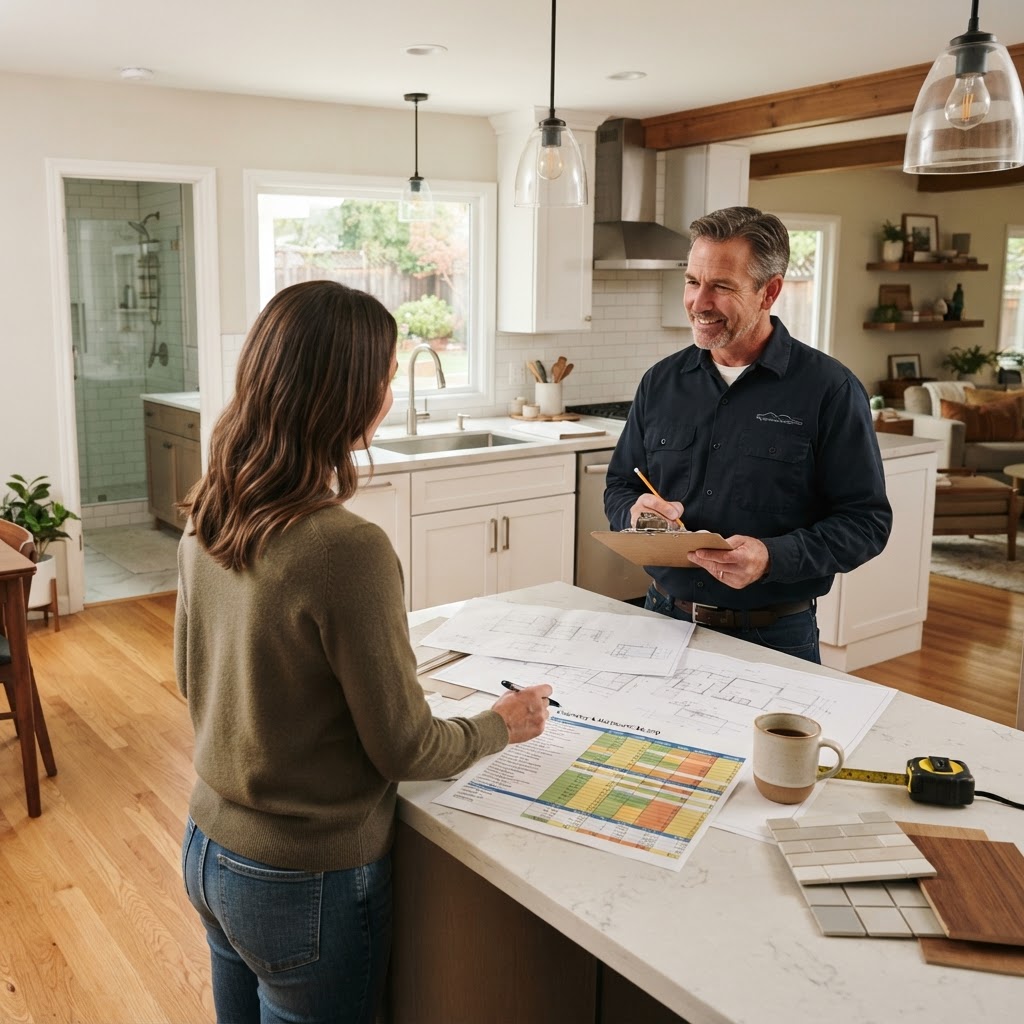
Remodeling Budget Strategy: How to Spend Your Money Wisely
Remodeling costs can shift when project scope or material selections change, or when demolition reveals conditions that weren't visible before the walls were opened. Materials get swapped, scope gets adjusted, and hidden conditions can surface once work begins. Understanding where your money is actually going lets you make deliberate trade-offs instead of reacting to surprises mid-project.
Know Where the Money Actually Goes
Before you can decide where to spend more or less, you need a realistic picture of how a remodeling dollar typically breaks down. For a kitchen remodel, industry budget guidance from the National Kitchen & Bath Association puts allocation in roughly this range: cabinets and hardware 25-30%, installation and labor 20-25%, countertops 10-15%, appliances 10-15%, plumbing and electrical 5-10%, flooring 5-10%, and design and permits 5-10%. These percentages shift depending on project scope and the materials you choose, but the pattern holds up across most projects: cabinets are consistently the single largest line item, followed by labor, then countertops and appliances.
That ordering matters because it tells you where the real money lives. Before adjusting smaller, easily replaceable items, it's worth reviewing the larger budget categories first — particularly cabinets and labor, since those are consistently the biggest cost drivers in a kitchen remodel. A useful question to ask a supplier or contractor before you commit to a purchase: "Which line items in this estimate are fixed by the scope of the project, and which are flexible based on material or brand selection?" That question tells you where adjusting your specification will actually move the total, rather than guessing based on a single smaller category.
Bathroom remodels follow a different cost logic. Plumbing relocation, waterproofing, tile selection and area, fixture quality, and whether the layout changes are the primary cost drivers, and moving plumbing fixtures is consistently one of the biggest single factors in the budget. If a bathroom project is stretching your budget, the layout — not the finishes — is usually the first place to look.
Spend on What's Permanent, Save on What's Replaceable
This is the core idea behind value engineering, and it's a useful filter for almost any decision on a remodel: prioritize spending on the elements that are permanent or hard to change later — layout, plumbing, electrical, cabinets — and look for savings on elements that are easy to swap down the road, like hardware, lighting, and accessories.
In practice, that means prioritizing cabinet construction and layout, since cabinets fall into the permanent, hard-to-change category that value-engineering guidance recommends funding first, while hardware, lighting, and accessories are the easier places to look for savings later. Before you commit to a cabinet package, a useful question to ask a supplier is: "Which parts of this cabinet system are structural and permanent, and which parts — like handles, pulls, or interior organizers — can be swapped out later without touching the box itself?" That question helps you see where your spending decision is locked in versus where it stays flexible. The same value-engineering logic applies to plumbing and electrical work: industry guidance groups plumbing and electrical with layout and cabinets as hard-to-change elements worth prioritizing in the budget, while items like fixtures, hardware, and lighting are the easier places to look for savings.
Why Costs Shift Mid-Project
Even a well-planned remodel can move once demolition starts. Demolition can reveal conditions that weren't visible beforehand, including hidden water damage or rot, electrical wiring that needs a full rewire rather than a partial update, plumbing that doesn't meet current code, structural issues in walls opened for a more open layout, asbestos remediation, or lead remediation in pre-1978 homes.
Because some hidden conditions may not become apparent until demolition, it's worth deciding in advance how you will respond if one is discovered. That's a much stronger position than reacting to a change order in the middle of a project with no framework for the decision.
Build Your Own Numbers, Not a Generic Range
Actual project costs depend on the specific scope, materials, layout, and site or structural conditions involved, not a fixed formula that applies evenly across every kitchen or bathroom. Renovation by Design prepares custom estimates based on your project's scope, materials, and site conditions rather than publishing generic price ranges, because each kitchen remodel's cost depends on the specific layout, material selections, and structural conditions involved.
If you're trying to figure out where your money should go before you start pulling quotes, start planning with a clear scope and a list of priorities ranked by what matters most to you — layout, cabinet quality, countertop material, appliance package — and treat everything below that line as adjustable. That's the version of budget strategy that actually holds up once real numbers start coming in.
Renovation by Design prepares custom estimates based on project scope, materials, and site conditions. Start planning your project.